Hazardous Tree Identification: Warning Signs Every Bloomington Homeowner Should Know
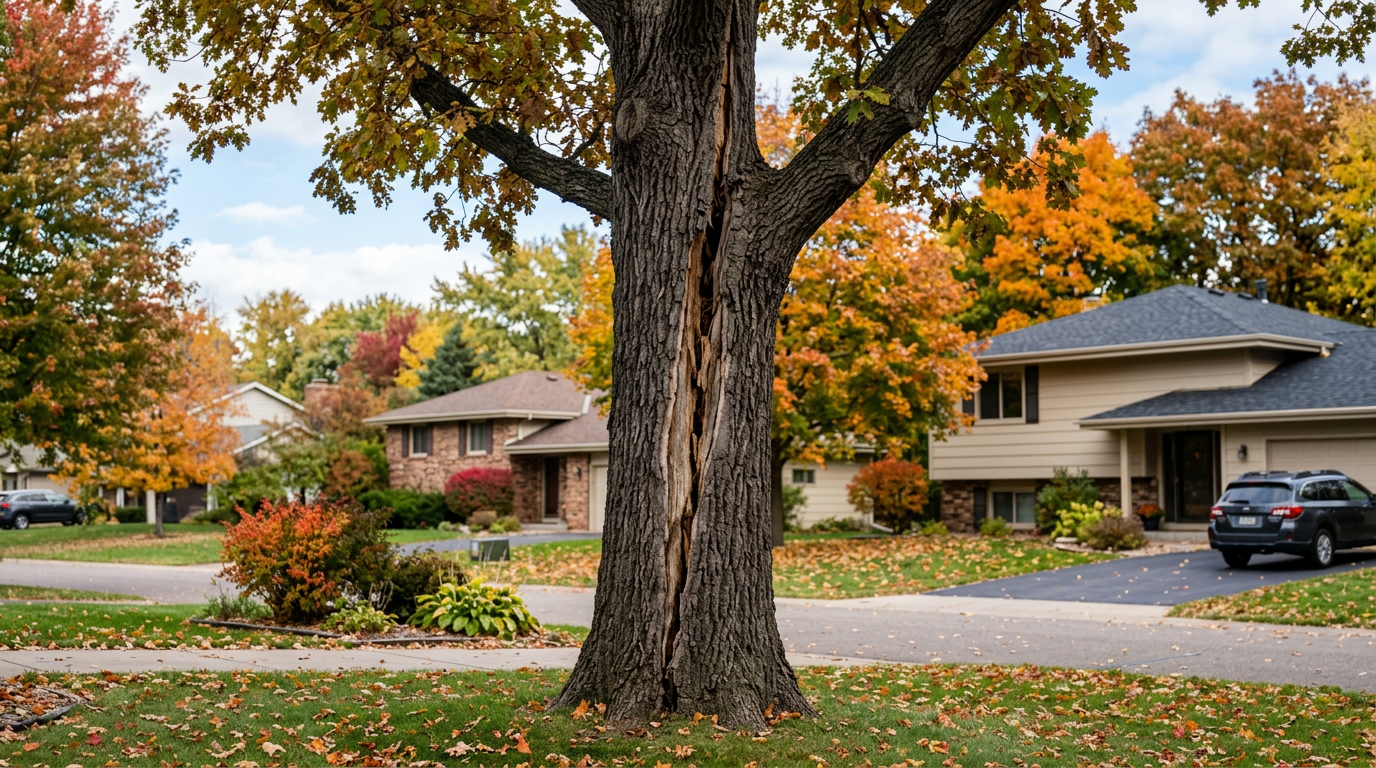
Living in Bloomington, Minnesota, means enjoying beautiful mature trees throughout our neighborhoods—from the towering oaks along the Minnesota River bluffs to the stately maples lining residential streets near the Mall of America corridor. However, our harsh continental climate, with its extreme freeze-thaw cycles and severe winter storms, creates unique conditions that can turn healthy trees into hazard trees overnight.
As ISA Certified Arborists serving Bloomington and the greater Twin Cities metro, we at Total Tree Care have responded to countless emergency calls where homeowners wished they had recognized the warning signs earlier. Understanding how to identify a dangerous tree can protect your family, property, and neighbors from potentially catastrophic tree failure. This guide will teach you the critical visual indicators that signal when a tree poses a safety risk and requires professional tree risk assessment.
Understanding Tree Hazards in Bloomington’s Climate
Minnesota’s humid continental climate presents specific challenges for tree health and structural integrity. Our region experiences temperature swings of over 100 degrees between summer highs and winter lows, creating tremendous stress on tree tissues. When combined with heavy snow loads, ice storms, and the prevalent freeze-thaw cycles that characterize our springs and falls, even healthy trees can develop structural weaknesses.
Tree failure in Bloomington often occurs during transition seasons when rapid temperature changes cause wood fibers to expand and contract repeatedly. This process can open existing cracks, weaken branch attachments, and compromise root systems. Additionally, our clay-heavy soils become saturated during spring snowmelt and summer storms, reducing root anchorage just when trees are most vulnerable to wind loading.
The emerald ash borer epidemic has also left many Bloomington properties with compromised ash trees that may appear healthy from the ground but have significant internal decay. These risky trees often fail without obvious external warning signs, making regular inspection crucial for homeowner safety.
Understanding these local factors helps explain why certain warning signs are particularly significant in our climate zone and why professional tree safety evaluation should be part of regular property maintenance.
Critical Visual Warning Signs of Tree Failure
Structural Cracks and Splits
The most immediate danger sign is visible cracking in the trunk or major branches. Look for vertical cracks that extend through the bark into the wood, particularly on the side of the tree facing prevailing winds or your home. In Bloomington’s climate, these cracks often develop during winter freeze-thaw cycles and expand each year.
Horizontal cracks or splits where branches attach to the trunk indicate failing branch unions—a common failure point during ice storms. Pay special attention to trees with multiple trunks or co-dominant stems, as these naturally weak attachment points are prone to splitting under load.
Fresh sawdust or wood shavings around the base of cracks may indicate active insect boring, which accelerates structural failure. Any crack wide enough to insert a coin requires immediate professional evaluation, as these represent significant structural compromise that could lead to tree falling risk.
Cavities and Decay Indicators
Tree cavities or hollow sections significantly reduce structural strength, even if the tree maintains a healthy canopy. Look for holes in the trunk, missing bark sections, or areas where you can see into the tree’s interior. Woodpecker activity often indicates internal decay, as these birds target insect-infested wood.
Fungal conks—shelf-like growths protruding from the trunk—are perhaps the most reliable indicator of internal decay. These fruiting bodies only appear when extensive rot has already compromised the tree’s structural integrity. Common species in Bloomington include bracket fungi and artist’s conk, which indicate advanced heart rot that creates a hazardous tree situation.
Soft, spongy, or discolored bark that can be easily pressed with your finger suggests cambial death and internal decay. This condition is particularly common in ash trees affected by emerald ash borer and in maples subjected to repeated freeze-thaw damage along the Minnesota River valley.
Changes in Tree Lean and Root Issues
While many trees naturally lean slightly, sudden changes in lean or new tilting indicates root failure or soil movement. After heavy rains or during spring snowmelt, walk around your trees and note any changes in their vertical orientation. Even a few degrees of new lean can signal imminent failure, especially for trees near houses.
Root heaving—where soil around the base appears raised or cracked—indicates the root system is pulling away from the ground. This is particularly dangerous in Bloomington’s clay soils, which can become saturated and lose bearing capacity rapidly. Look for exposed roots on the side opposite the lean, as this indicates the tree is literally pulling itself out of the ground.
Construction damage to root systems, even from several years past, can manifest as gradual lean development. Trees near recent excavation, utility work, or grade changes around Bloomington’s expanding commercial developments should be monitored closely for stability issues.
When Professional Tree Risk Assessment Becomes Essential
While homeowners can identify obvious warning signs, comprehensive tree risk assessment requires specialized training and equipment. ISA Certified Arborists use standardized protocols like the Tree Risk Assessment Qualification (TRAQ) methodology to evaluate failure probability and potential consequences systematically.
Professional assessment becomes critical when trees exhibit multiple warning signs, are located near high-value targets (homes, power lines, frequently used areas), or when insurance companies require documentation for coverage decisions. In Bloomington’s commercial corridors and dense residential neighborhoods, the potential for property damage and liability makes professional evaluation a wise investment.
Tree safety assessment involves more than visual inspection—it includes soil assessment, advanced decay detection tools, and load calculation based on local weather patterns. Our team at Total Tree Care combines ISA certification with extensive local experience to provide accurate risk evaluation that protects both property and people.
The assessment process also considers the specific tree species, age, and local environmental factors unique to Bloomington. For example, silver maples common in older neighborhoods have different failure patterns than the Norway maples planted in newer developments, and this species-specific knowledge is crucial for accurate tree safety concern evaluation.
Signs a Tree Is About to Fall: Immediate Action Required
Some warning signs indicate imminent danger and require immediate professional attention. If you notice any of these conditions, contact an ISA Certified Arborist immediately and avoid the area beneath the tree:
Sudden lean development after storms or heavy rain, especially if accompanied by soil cracking or root exposure. This indicates active root failure and potential imminent collapse.
Large dead branches hanging in the canopy (widow makers) pose immediate danger to anyone beneath. These can fall without warning, particularly during wind events common in Bloomington’s open landscape.
Fresh cracks that appear after storms, especially those that extend more than halfway through the trunk diameter. These represent critical structural failure that can progress rapidly.
Multiple fungal conks appearing simultaneously often indicate advanced decay that has reached a critical threshold. The tree’s structural integrity may be severely compromised.
How to Tell If a Tree Is Dangerous: A Homeowner’s Checklist
Regular inspection using this systematic approach can help identify dangerous trees before they fail:
Monthly visual inspection: Walk around each tree, looking up into the canopy and down at the root zone. Note any changes from previous inspections.
Post-storm assessment: After severe weather, inspect trees for new damage, including broken branches, fresh cracks, or changes in lean.
Seasonal evaluation: Pay special attention during spring when freeze-thaw cycles are most active and fall when trees are preparing for dormancy.
Professional consultation: Schedule annual inspections with ISA Certified Arborists for trees near structures or high-use areas.
Protecting Your Bloomington Property Through Proactive Tree Care
Tree safety begins with regular inspection and proactive maintenance. Walk your property monthly, particularly after severe weather events, and document any changes in tree condition with photographs. Pay special attention to trees within falling distance of your home, vehicles, or areas where people gather.
Proper tree care, including regular pruning by ISA Certified Arborists, can prevent many hazard situations from developing. Structural pruning removes weak branches before they fail, while crown cleaning eliminates dead wood that poses immediate danger. However, some situations require complete tree removal to eliminate risk entirely.
At Total Tree Care, we’ve served Bloomington homeowners and businesses for years, helping them navigate the balance between preserving valuable trees and maintaining safety. Our ISA Certified Arborists understand the unique challenges posed by Minnesota’s climate and the specific needs of properties from the Mall of America area to the residential neighborhoods along the Minnesota River bluffs.
Don’t wait for the next severe storm to discover you have a hazardous tree on your property. Early identification and professional assessment can prevent property damage, injury, and costly emergency removals.
Contact Total Tree Care today for a comprehensive tree risk assessment. Our ISA Certified Arborists serve Bloomington, Richfield, Minneapolis, St. Paul, Rosemount, Farmington, Hastings, and throughout the Twin Cities metro area. We provide the expertise you need to keep your property safe while preserving your valuable urban forest.
Call us now (651) 318-4480 to schedule your professional tree evaluation and gain peace of mind knowing your trees are properly assessed and maintained by certified professionals who understand Bloomington’s unique tree care challenges.
